John KEADY (1812-1884) Shady dealings with the authorities or just smart ?

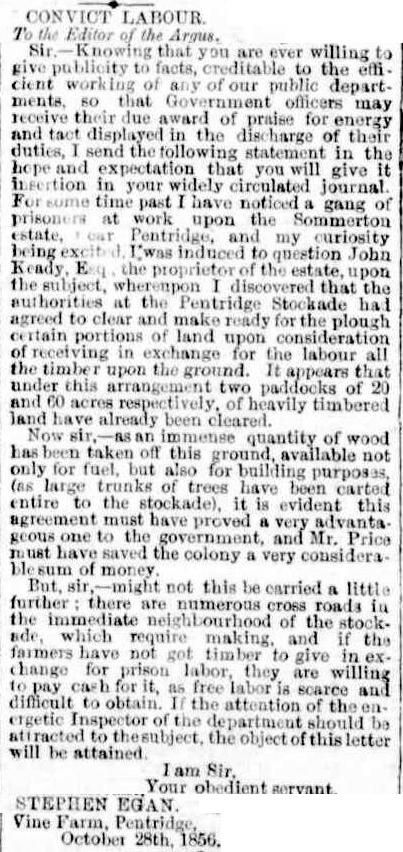
The “Letter to the Editor” below appeared in “The Argus” (The Age) on Friday, 31 October, 1856 from Mr Stephen Egan of Vine Farm, Pentridge (later to be renamed as present day Coburg).

Mr Egan was a neighbour of John KEADY with land holdings near the Pentridge Village, leading down to the Merri Creek. It is not clear if he was an immediate neighbour or just living in the vicinity.

Mr Egan’s letter needs to be considered in the context of life in the Port Phillip colony in the mid 1850s.

The Gold Rush is in full swing at this time, with labour in very scarce supply because everyone is heading off to the gold fields to make their fortune. Even ships arriving in Port Phillip to deposit the increasing number of immigrants have real problems leaving because the sailors who man the ships are jumping ship and heading to the Goldfields.

Crime is a real problem with the vast number of immigrants. There is a real need to expand the Pentridge Stockade (later to be Pentridge Prison) which was established in 1851 to house the criminals of the Colony. The Pentridge Stockade was undergoing a major expansion when Mr Egan wrote his letter.

In a nutshell, John KEADY has done a deal with the Pentridge Stockade Governor to use prisoners to clear his land and in return the Governor gets access to the felled trees to enable construction of his Stockade. The real advantage for John KEADY is the clearing of his land; 80 acres is mentioned in the article. Besides labour being in very short supply at the time, so also was good arable land close to Melbourne which could be used to grow crops to feed the ever expanding population. John Keady’s land would no doubt have increased in value substantially when it was cleared.

Stephen Egan seems to suggest that John Keady’s deal with the Governor is a bit shady and the labour of the prisoners would be better applied to building roads. Although, perhaps Mr Egan is just annoyed that he hasn’t had the chance to get in on the action and get access to this scare labour for himself.

Irrespective of Mr Egan’s motive for writing, the article gives a great insight into how John KEADY was able to develop some of his land holdings in the early Port Phillip colony.
Irish Families Stick Together

The Keady family no doubt formed close friendships with other Irish immigrants when they arrived at Port Phillip in November 1841. One family in particular, Mathew “Barney” and Johanna O’Leary formed a close relationship with John and Honora Keady.

Mathew John “Barney” O’Leary and his wife Johanna (nee Lombard) arrived at Port Phillip aboard the “Enmore” from Cork, Ireland on 4 October, 1841 about a month before John and Honora Keady arrived. They brought their daughters Johanna who was 5 years old and Betty who was only 8 months old.

The trip from Cork for the O’Learys and the other 96 sponsored immigrants took them just over 4 months. The shipping record notes that Barney and Johanna could not read or write and that Barney’s occupation was “Farm Servant”.

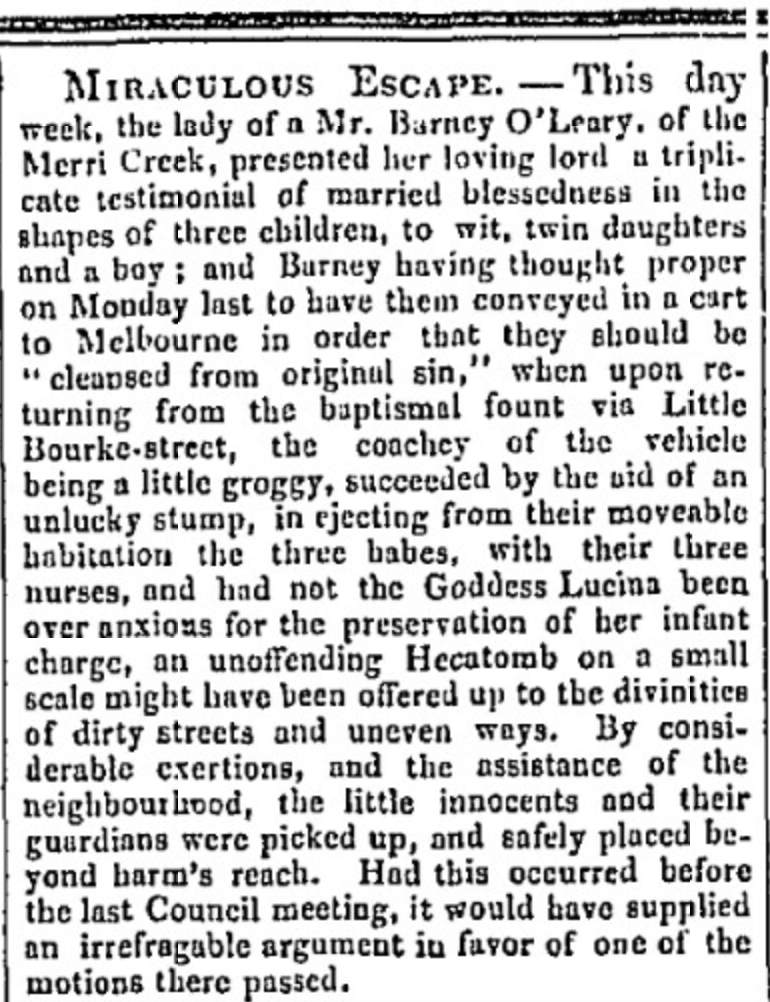
By 1845 the O’Learys were living at Merri Creek, the same location that John and Honora Keady had established a home for their family. We know the O’Learys lived at Merri Creek because they received some notoriety because of an incident near the corner of Little Bourke Street and Swanston Street in April 1845.

The article below from “The Port Phillip Herald” of 3 April 1845 gives a good explanation of the near tragic accident.

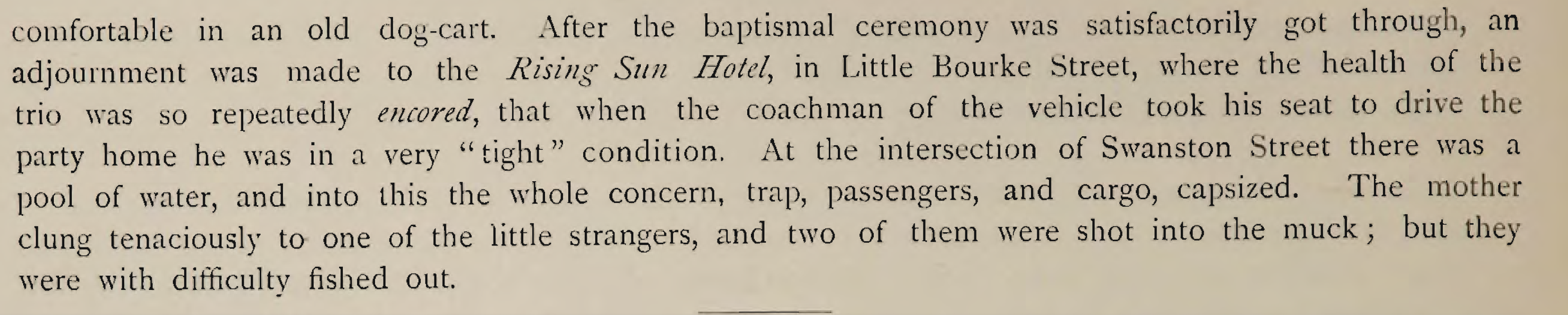
Also the following article from “ The chronicles of early Melbourne, 1835 to 1852: historical, anecdotal and personal/by “Garryoweb”” gives a slightly less artistic description of the incident. It is worth noting that it is reported that the triplets were only the 2nd set of triplets born in the colony.

The triplets were Ellen, Mary Anne and John. Baptism records show Barney and Johanna had two other children after they arrived in Australia, Catherine, 1843 and Mary in 1846.

Jumping forward 24 years and John Francis Keady (1840-1902 ) marries Margaret O’Leary at St Patrick’s, Kilmore on 1 November, 1869. Details on the Marriage Certificate means Margaret would have been born in 1835, and her place of birth was given as County Limerick, Ireland. This would suggest that the “Johanna” listed on the shipping record was indeed Margaret.

The following image is the only known photo of Margaret which was found in the family bible of John Francis Keady.

Elizabeth Keady (1845-1904)

Elizabeth Mary Josephine KEADY (1845-1904)

John and Honorah’s eighth child, Elizabeth was born at Merri Creek, Melbourne in 1845.

No information has been found on her early life.

Elizabeth was 29 years old when she married Michael Daniel Daly in 1874.

Elizabeth and Michael’s first child Catherine was born in Nagambie, 1876 and their second child Nora Teresa Daly was born in 1878.

Tough Times for Elizabeth

Michael Daly died relatively young at only 38 years old on the 14 March 1878 at Dookie. Elizabeth was left as a widow looking after a 2 year old (Catherine) and a newborn (Nora) or possibly she was still pregnant at the time of Michael’s death. The circumstances of Michael’s death are not known.

The probate papers for Michael Daly reveal that he was a storekeeper at the township of Dookie South (later called Cashel) which by 1902 was virtually deserted. When the railway was extended from Shepparton to an area about 3km north of Cashel in 1879, this spelt the end of Dookie South. The new township which sprung up around the station became the township of Dookie.

Elizabeth must have been left in dire straits because the probate papers show that Michael died with debts in the order of 2,000 pounds. Although he owned some houses and land in the Main Street of Dookie South (Cashel), he had a significant mortgage and huge debts associated with stock for his store. He even owed 100 pounds to Patrick Keady, presumably Elizabeth’s brother.

Perhaps Patrick knew of Elizabeth’s financial predicament because he renounced any claims and rescinded his duty to act as an Executor for Michael’s will.

Elizabeth marries John Doyle

Three years after Michael Daly’s death, Elizabeth married John Doyle in 1881 at the age of 36. Elizabeth goes on to have three children, John Henry Doyle born 1883, Alicia Agnes Doyle, born 1884 and Gratton John Doyle also born in 1884.

Michael and Elizabeth seemed to have been moving around a bit, with John Henry born in Melbourne, Alicia in Seymour and Gratton John in Dookie.

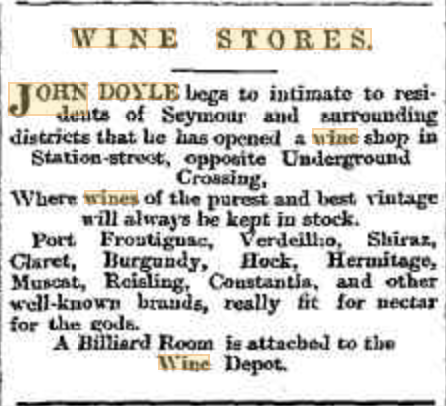
In 1888 John applies for, and presumably is granted a colonial wine licence for a store in Station Street, Seymour, directly opposite the railway station. For the next few years he regularly advertises in the local newspaper.

The advertisement below appeared in “The Seymour Express of 5 August, 1890”.

Sourced from Trove,

Elizabeth dies in 1904 at which time she is living at Worrough just outside Seymour.

William James Alipius Keady (1845-1930)

William was the youngest son of John and Honorah Keady. He was born in 1845 in Melbourne.

William would have spent most of his early life around Pentridge (Coburg area), between Sydney Road and Merri Creek.

Marriage

William married Catherine Priscella Julia “Kate” Hennessy on 16th May 1876 at St Patrick’s Cathedral, Melbourne. Kate was the daughter of James Hennessy of Nicholson Street, Carlton. Kate’s brother, Sir David Valentine Hennessy was a notable figure in public life at the time spending some time on Brunswick Council and was Lord Mayor of Melbourne from 1912-1917.

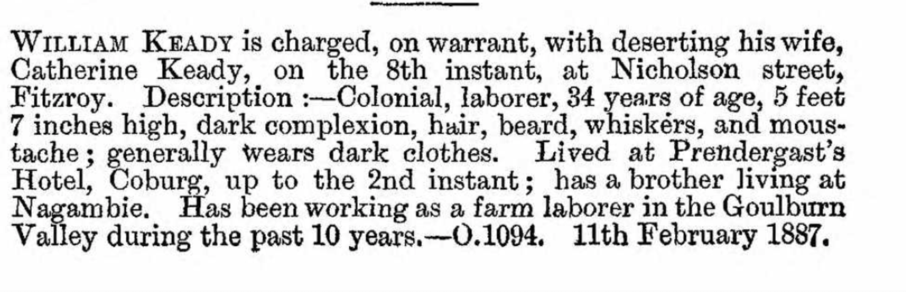
William and Kate seem to have had a rocky marriage. In 1887, William is charged with deserting his wife. The notice in the Police Gazette of February 16, 1887 says that William has been working in the Goulburn Valley for the last 10 years. The notice gives a good description of William.

A subsequent notice in the Victorian Police Gazette of the same year notes that William was arrested on 5 August 1887 in Fitzroy for deserting his wife.

In 1894 Kate lodges an application for divorce with the Supreme Court. It is understood that she was successful and they were divorced that year.

William’s marital status was a matter of concern to his father John. In John’s Will which he wrote in June 1884, just 6 months before his death on 21 December it would seem that John had lost contact with his son, William. John specifically writes in his Will that the Executors were not to give William any financial inheritance unless they are satisfied and had reliable proof that William was living with his lawful wife. Furthermore, John does not know where William is living.

 To my son William Keady of ———————— in the said Colony —————— the sum of Two Hundred Pounds provided that my executors have satisfactory and reliable proof that he is living with his lawful wife at the time of my death and if not, the same is to be divided between my other four sons and two daughters share and share a like or their heirs and assigns. 

(Extract from John Keady Will, 5 June 1884)

In latter years William seems to have had trouble with the “Drink”.

In 1902, at the age of 57, William is charged with breaking into the Mooroopna North Hotel and stealing 16 bottles of Ale and a bottle of Whiskey. At his trial on the 16 November, 1902 William pleads guilty, claiming that he was intoxicated at the time of the break-in. He was sentenced to a months jail on each of two charges. The notice of his discharge from jail indicates his occupation was, gardener.

There is limited information about his latter years, the last record in the electoral rolls shows him living in Windsor in 1925 with his occupation given as gardener.

William died in 1930 at 85 years of age. He was buried in a public grave at Springvale Cemetery on 19 August, 1930.

Keady Family Tree

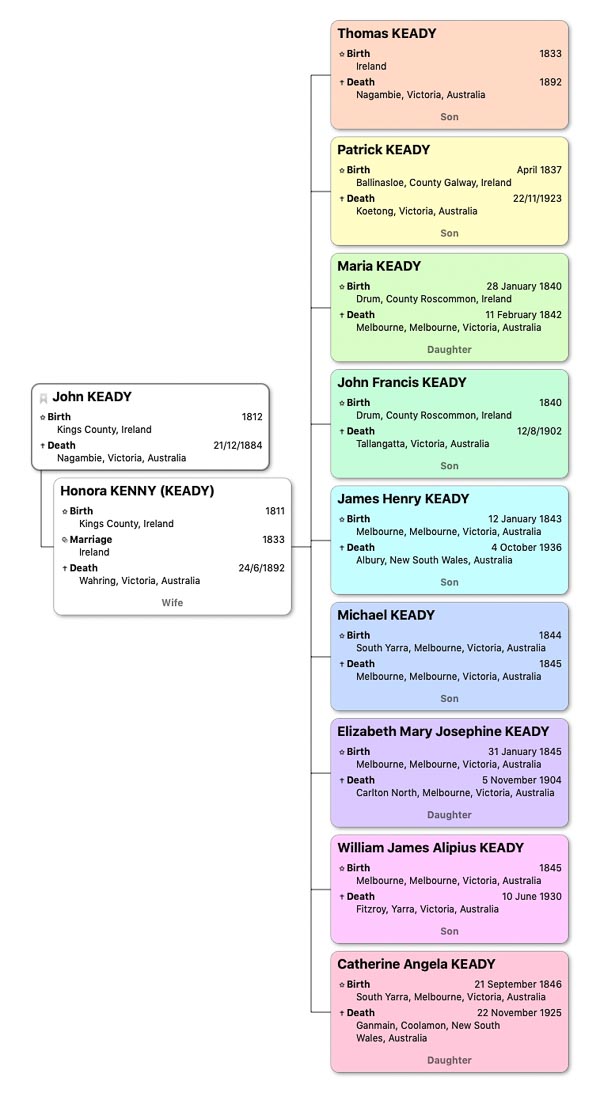
The Family tree below provides the basic details of the first Keady family in Victoria. Keep in mind that the dates and locations related to John and Honora’s life in Ireland are so far pretty much based on working backwards from information and records available in Australia.

For example, the shipping records show the family originated from King’s County, Ireland, however, Gravestones and death certificates refer to County Roscommon.

The only confirmed record sourced from Ireland relates to the Baptism of Patrick Keady on 27 April, 1837 at Laurencetown, County Galway. (The art of finding Irish records seems to come down to luck more than anything. If you are able to find a rough location, it then becomes an exercise in reading a photocopy of a page in a 180 year old parish register, hand written by a Parish Priest, in latin, more often than not using shorthand. So, put your hand up if you’re an expert in deciphering shorthand latin !)

Future blogs will provide details for each of the children including their spouse and children.

First Generation of Keady Family in Victoria (2019)

Keady watering hole

Keady and Gerecke families share an ale at the Welcome Hotel, Koetong

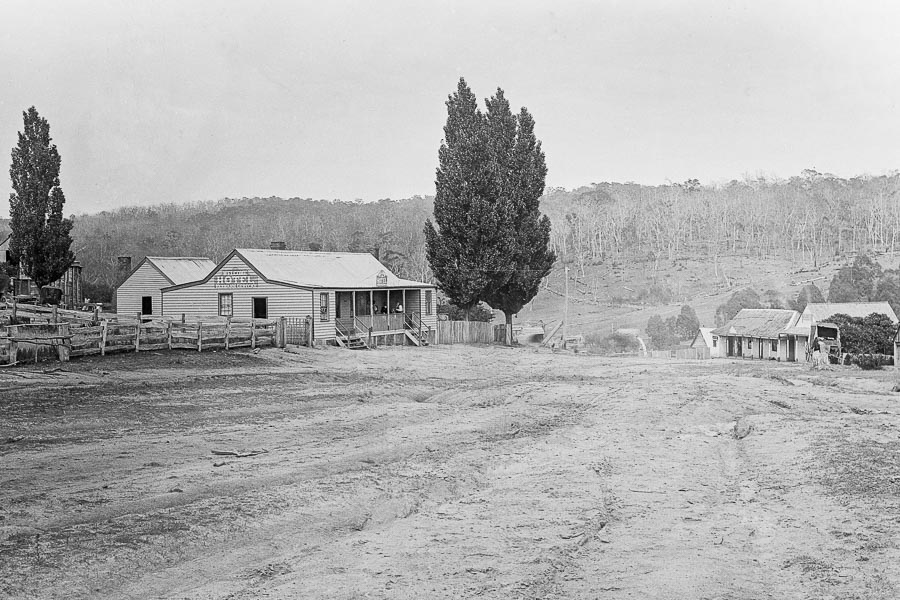
Welcome Hotel, Koetong cc 1895. Source: State Library of Victoria

This beautiful photo of the Welcome Hotel at Koetong is believed to have been taken about 1895.  The proprietor was Hermann Gerecke, a German immigrant who arrived in Australia in 1857.

The Keady families of John Francis Keady (1840-1902) and Patrick Keady (1837-1923) moved to the Koetong area about the mid to late 1890s when land became available for selection.  Tin mining was also a major attraction to the area.  John and Patrick’s brother James Henry Keady (1843-1936) also moved to this area and was involved in tin mining.

The licencing records of the times suggest there were only two pubs in town, the Koetong Hotel and the Welcome Hotel. Perhaps the Koetong Hotel is the other building in the distance on the right.

There weren’t many people in the town and surrounding district so no doubt the Keady families enjoyed a few ales at these pubs.  In 1903 there were only 100 people listed on the Electoral roll for Koetong, including 13 Keady family members. Some of the family may even be one of the three bearded gentlemen standing on the verandah in this photo.

The links between the Gerecke and Keady families were to become stronger as the years progressed. 

Patrick Keady’s son, John Henry Keady (1867-1929) married the eldest daughter of Hermann Gerecke, Christina Frances Gerecke (1874 -1941) in 1901. This couple would go on to become publicans of the Everton Hotel.

Just to keep the family ties strong, Patrick’s daughter, Honorah Ann (Nora) Keady (1880-1937) married William Herman Gerecke(1875-1947), Hermann’s eldest son in 1901.  Perhaps it was a double wedding. In 1904 William took over as publican from his father.

Both the Welcome and Koetong Hotels were a focus for community sporting and social gatherings.  Newspaper reports of Keady family activities will follow in future blogs.

Somerset Estate 1854

John Keady puts his Estate up for sale in 1854 with thoughts of moving back to Ireland.

After arriving in late 1841 with his wife, Honorah and four young children, John Keady certainly seems to be doing well in his new home by the mid 1850s.

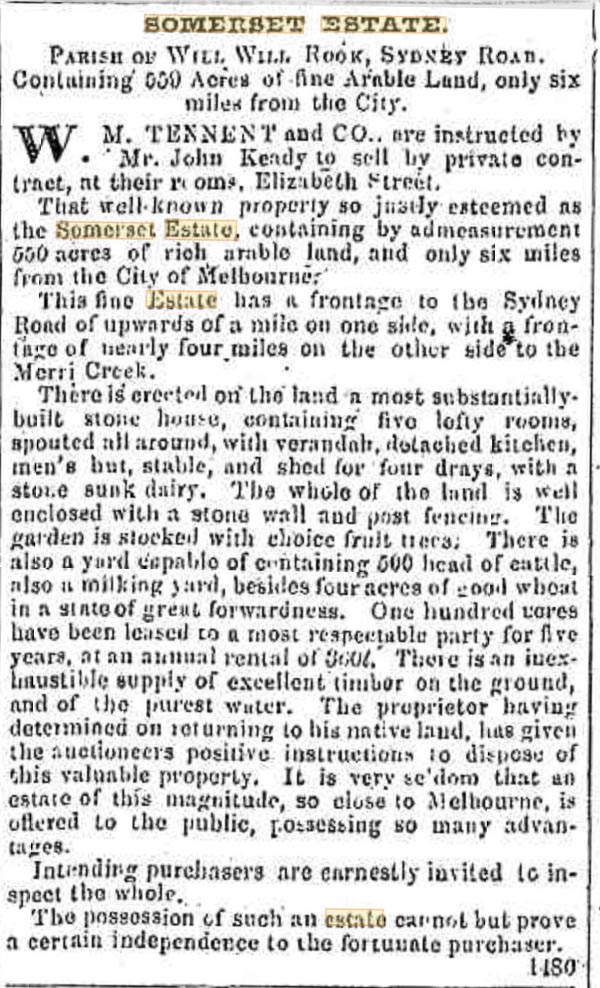
In 1854 he places on the market his land known as the “Somerset Estate” which comprises 550 acres, just 6 miles from Melbourne.  It is described as having a frontage of 1 mile along Sydney Road and 4 miles along the Merri Creek.   The advertisement talks about Mr Keady selling up so he can return to his native land, but clearly this didn’t happen.  

John seems to be doing exceptionally well from the description of the property.  Well worth the read to see how John and the family were living.

The naming of his land, “Somerset Estate” provides one of the few clues as to his origins in Ireland.  While many would immediately think of Somerset in England, Somerset is also the name of a small Townland in County Galway, near the town of Laurencetown. The connection is certainly confirmed with the baptism of his second son, Patrick, in Laurencetown on 8 April, 1837.

Imaging the value of this land these days !

Arrival of Keady Family

Port Philip Bay 1841

The first Keady family arrived in Australia on 29 November 1841 when John, his wife Honora and their four children sailed into Port Philip Bay on the Frances from Liverpool.

At that time Melbourne was still part of the Colony of New South Wales.  Victoria was not proclaimed as a separate Colony for another 10 years in 1851.

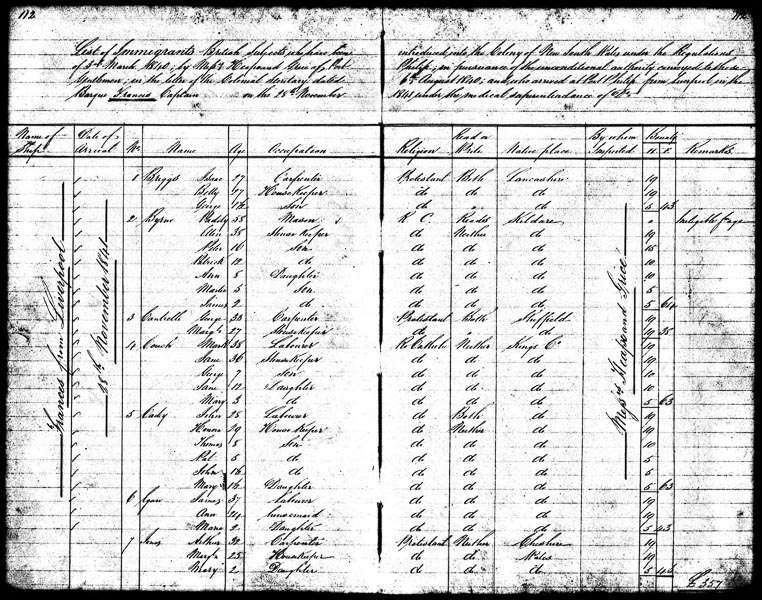
Page 1 of the shipping log. Keady family is No 5.

John and his family had sailed from Liverpool on 20 August 1841 for a journey which took just over 3 months.  The barque, Frances weighed 332 tons.  Apart from a handful of paying passengers, there were 92 immigrants on board who were sponsored by a newly established merchant company, “Heape and Grice”.

John and Honora were travelling with four children, Thomas (8), Patrick (5) and twins John and Mary who were 1 ½ years old.  There were 14 other family groups, 15 single males and 15 single female passengers.  Overall the passengers seem to have been relatively well educated for the times, with 41 of the passengers being able to read and write. 

As you can see in the extract from the shipping list, John Keady could read and write, while Honora could do neither.  It seems that John did not check the shipping list as the family name has been recorded as “Cadey” not Keady.  Possibly the clerk was English and John would have had a strong Irish accent.

“You’ll never get seedy at the Keady”

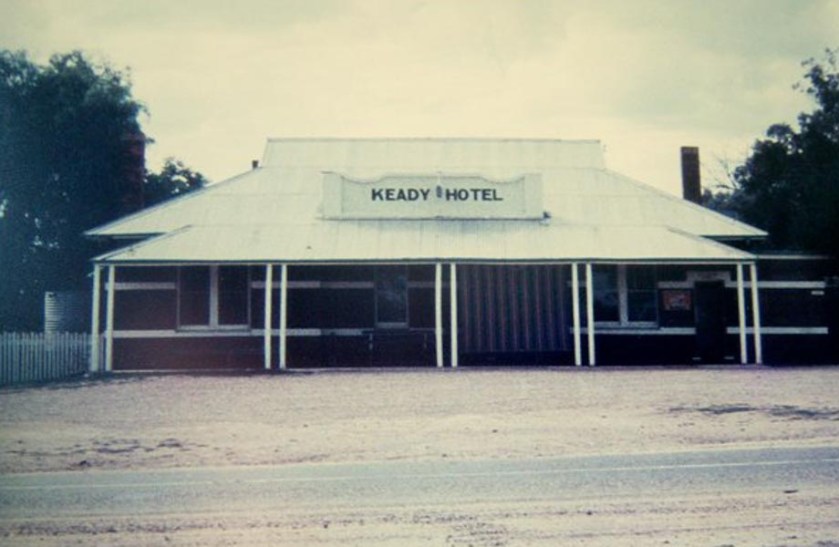
Keady Hotel, Everton, Victoria. (now Everton Hotel)

Good advice behind the bar at the Everton Hotel, formerly the “Keady Hotel”.

There seems to have been something in the blood which lead Keadys thru the generations to have a go at running pubs.

John Keady (1812-1884) kicked off the tradition when he became the Publican of the Prince Alfred Hotel in High Street, Preston in 1876. He renamed it, “Keady’s Hotel”, remaining the Publican until 1882, when the name reverted to the Prince Alfred Hotel.  It closed as a pub in 1922, but the building remains at 133 High Street, Preston, Victoria.

John’s son James Henry Keady (1843-1936) was also running a pub about the same time in Murchison through the late 1870s until he got into financial difficulties.

While John’s son Patrick (1837-1923) did not seem to have a go at running a pub, three of his sons certainly kept up the family tradition.

John Henry Keady (1867-1929), along with his wife Christina Gerecke(1874-1941) operated the Keady Hotel at Everton over the period from 1904-1937.  The Keady (now Everton) Hotel hasn’t changed much since that time.

Patrick’s son, Michael Thomas Keady (1869-1940) spent most of his working life as a publican in New Zealand.  Michael moved to New Zealand with his brother Patrick John Keady (1876-1951) after returning from service with the Australian 3rdNSW Mounted Rifles during the Boer War.  Michael ran pubs are various locations including the Edinburgh Castle Hotel in Auckland where he was the publican in 1919.  Both Michael and Patrick lived out their lives in New Zealand.

The Koetong Hotel on the Murray Valley Highway between Albury and Corryong was also in Keady hands in the early 1900s.  The publican is recorded as James Keady, but it is not clear if this was James Henry Keady, noted above or his nephew, James Keady (1890-1941) another son of Patrick Keady.  Irrespective of who was the publican, one can imagine that the Koetong Hotel was a regular water hole for the two large Keady families who lived at Koetong at the time. The Koetong Hotel still serves a cold beer.

Does Daniel Keady fit in the Keady family tree ?

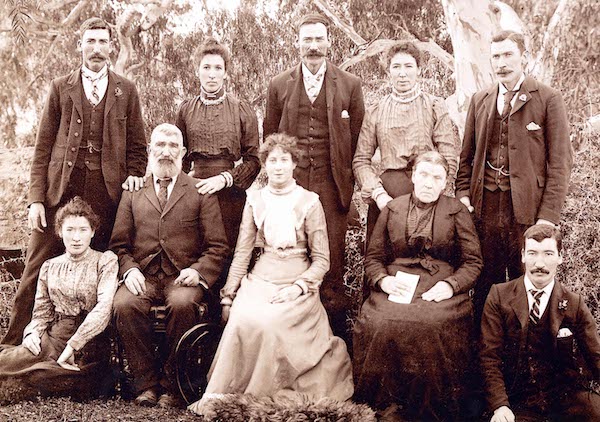
The family photo below is Daniel Keady (1838 – 1928), wife Bridget O’Shea (1839 -1914) and seven of their eight children.  In addition, the young woman standing directly behind Daniel is Margaret Frances Keady (1886 -1982).  The photo was taken sometime before 1914.

Margaret is the 2ndyoungest daughter of James Henry Keady (1843-1936), the younger brother of Patrick and John Francis Keady whose pictures appear in earlier blogs.

Daniel and Bridget raised Margaret after her mother (Margaret Rose McManus) died in 1890 at which time Margaret would have been only 4 years old. The other four children of James Henry Keady and Margaret McManus seem to have been raised by the McManus family.

Daniel Keady and Family (prior to 1914)

It would appear that James Henry felt he could not raise five children under 10 and he leaves the Nagambie/Murchison district and moves to the Koetong area near Corryong where he is identified as a miner in a number of sources.

Back to the mystery !

No one has yet found any shipping record for Daniel, nor any articles or resources which might shed any light on a relationship between Daniel Keady and the family of John and Honora Keady.  

The fact that Daniel fostered James Henry’s daughter and they owned adjacent properties in the Murchison area suggests a family tie, but who knows, maybe they just met in a pub and struck up a strong friendship based on a common surname.